
ORCL Stock: Price Movement & What the Data Says
Generated Title: Oracle's AI Gamble: Is ORCL Stock a High-Stakes Poker Hand or a Calculated Bet?
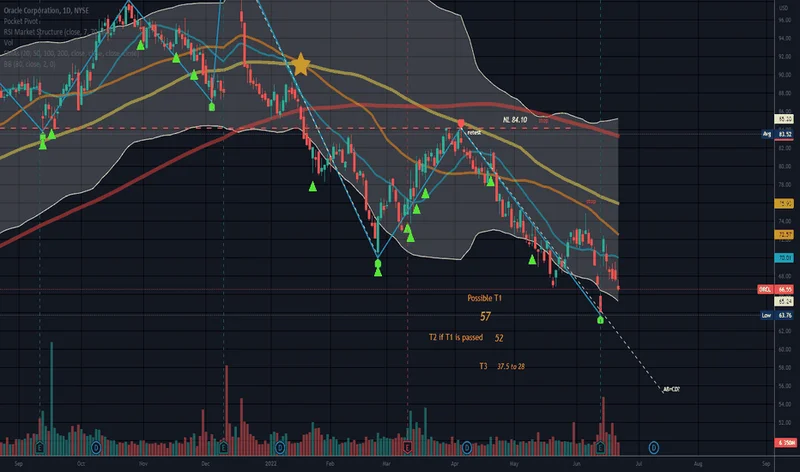
Oracle. The name conjures images of sprawling server farms and enterprise software, not exactly the bleeding edge of AI cool. Yet, here we are, discussing whether Oracle's aggressive push into AI infrastructure is a stroke of genius or a reckless gamble. The recent volatility in ORCL stock price—a 30% drop in a month—certainly suggests investors are having second thoughts. But is this fear justified? Let's crunch some numbers.
Decoding the Remaining Performance Obligations
The initial surge in ORCL stock followed the announcement of a massive $455 billion in remaining performance obligations (RPOs), a 359% increase year-over-year. That’s insane growth. The market interpreted this as a clear sign that Oracle was winning the AI race. But here's where skepticism is warranted. RPOs represent future revenue under contract. They aren't cash in hand. It's like counting your chickens before they hatch—or, in this case, counting servers before they're even racked.
DA Davidson analyst Gil Luria pointed out a critical detail: OpenAI accounted for almost the entire increase in Oracle's backlog. Since then, OpenAI has announced over $1 trillion in AI data center contracts with other players. Luria suggests that Oracle was merely a pawn in OpenAI's game of "fake it 'till you make it." Ouch.
This raises a crucial question: How diversified is Oracle's AI customer base? If a single client (OpenAI) represents a disproportionate share of future revenue, Oracle's AI narrative rests on shaky ground. It's a classic case of concentration risk, and the market hates concentration risk.
Free Cash Flow Realities
Oracle's Q1 numbers revealed a concerning trend: negative free cash flow (FCF) of -$362 million, driven by a massive increase in capital expenditure (capex) to $8.5 billion (compared to $2.3 billion a year ago). This isn't necessarily bad. Companies investing in growth often sacrifice short-term profitability for long-term gains. However, the scale of Oracle's capex spending demands scrutiny.
Are these investments generating sufficient returns? Are they truly strategic, or is Oracle simply throwing money at the AI problem in the hopes that something sticks? The answer, as always, lies in the margins. Oracle's operating cash flow (OCF) margin for the quarter was a healthy 54.5%. Projecting that forward, and assuming revenue of $75.265 billion for the next 12 months, OCF could reach $34.2 billion.
But here's where I find a discrepancy. Even using a conservative OCF yield of 3.67% (Oracle's current level), that implies a market cap of $931 billion—a 58.8% upside from today's levels. That translates to a price target of $325.87. Analysts, on average, are even more bullish, with a consensus price target of $342.28.
And this is the part of the report that I find genuinely puzzling. Are analysts genuinely convinced by Oracle's AI story, or are they simply extrapolating past performance and hoping for the best? It feels like the market is pricing in both massive upside and massive downside simultaneously.
The Options Market Speaks
Interestingly, the options market offers a more nuanced perspective. The Barchart Unusual Stock Options Activity Report highlighted a large volume of deep out-of-the-money (OTM) put options expiring in over a year, with a strike price of $105. This suggests that some investors believe ORCL stock could fall by nearly 50%. However, short-sellers of these puts are earning a one-year yield of 5.14%, betting that the stock won't fall that far.
This creates an intriguing dynamic. On one hand, you have bullish analysts projecting significant upside. On the other, you have options traders hedging against a potential collapse. The truth, as always, likely lies somewhere in between. As reported by Barchart, Unusual Activity in Oracle Corp Put Options Highlights ORCL Stock's Value.
So, What's the Real Story?
Oracle's AI gamble is a high-stakes poker hand. The company has bet big on AI infrastructure, leveraging its balance sheet and chasing massive RPOs. The question is whether Oracle can deliver on its promises and diversify its customer base. Until we see concrete evidence of sustainable growth and diversified revenue streams, ORCL stock remains a speculative bet, not a sure thing.